Leonhard Seppala - the Norwegian who started it all!  Posted: Posted: Tue Nov 21, 2006 9:13 pm |
|
|
|
|
Plenty of you are familar with Balto and Togo (especially Balto), and you have seen the introductions I've given you to Fritz, and some other things besides.
Here, in this new material, I will introduce you to the one man through whom the legacy of sled dog mushing, with Siberian huskies in Alaska, became a reality. Without the involvement of this scrappy, feisty little Norwegian man, the history of the serum run might have been VERY different!
This will be broken up into several posts, and I will also provide links to the historical research I did, so you can all see it for yourselves...bear with me!
|
|
|
|
 |
Posted: Tue Nov 21, 2006 9:36 pm |
|
|
|
|
SOME INITIAL HISTORY OF THE MAN
Birth And Childhood
Leonhard Seppala (pronounced LEH-nerd SEP-luh...NOT "LEE-ohn-hard Sep-PAH-la") was born in Skibotn, Norway on September 14th, 1877, the son of a fisherman who also worked as a blacksmith. Two years after his birth, his family moved to a farm near the town of Skjervøy. While his father went away on fishing trips and also worked in town as a smith, Leonhard was put to work (when he was old enough) on the family farm.
When he turned 12 years of age, Leonhard began accompanying his father on fishing trips to Finnmark, the northernmost county of Norway, to help on the boat. He baited hooks, cooked for the crew, and did their laundry. It was hard but lucrative work, which he did with his father every year until 1897.
At the age of 20, he felt it was time to move on and seek fame and fortune elsewhere. He left his family farm to travel to work in Kristiania (which is now Oslo), working for mechanical and smithy companies. He earned a diploma here doing this work. He also met his first girlfriend, Margit, in Kristiania. They fell in love, and he intended to marry her, but she died, which caused Leonhard's spirits to sink. He returned to Skjervøy to work in his father's smithy.
Last edited by (deleted user) on Wed Nov 22, 2006 7:42 pm, edited 1 time in total.
|
|
|
|
|
Posted: Tue Nov 21, 2006 9:54 pm |
|
|
|
Alaskan Beginnings
One of the "three famous Swedes" of Nome (the men who founded and bankrolled the town, and owned the Pioneer Gold Mining Company...the biggest gold mining operation in that area), Jafet Lindberg (who was actually Norwegian like Seppala) had returned to Norway in 1899 with plenty of gold in tow, and lots of amazing stories to tell of Alaska and the Klondike Gold Rush (different from the California Gold Rush of the 1840s - 1850s). Here's some information, from Wikipedia, on that: http://en.wikipedia.org/wiki/Klondike_Gold_Rush.
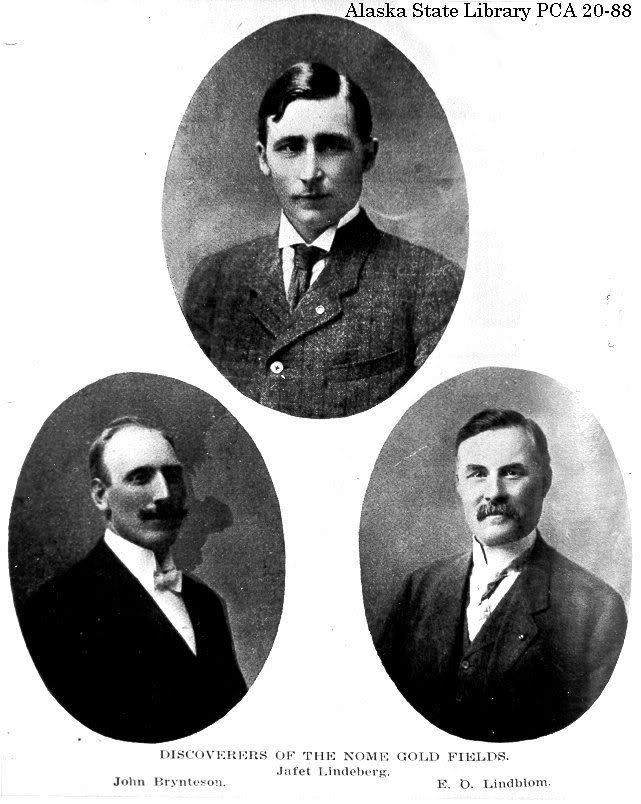 (Above: The "Three Lucky Swedes" of Nome...Jafet Lindberg at top, John Brynteson at left, and Erik Lindblom.)
Leonhard read about the goings-on in Alaska, and of the gold rush, and was amazed. And he wanted to be in on the action ( who wouldn't? They had to be amazing, if certainly dangerous, times!). Leonhard contacted Lindberg and asked about getting involved. Lindberg saw potential in the young man, and in his experience in mechanical works and smithing, and loaned Leonhard the money to book passage on a ship to America, so that he could get through to Alaska (which, at the time, was not officially a part of the U.S., but only a territory claimed by it...having been purchased from Russia in the 1800s). In 1900, Leonhard set out to seek fortune and glory.
Life in Alaska was far from easy. Nome was a rough-and-tumble, often near lawless gold mining town. In 1900, it was a mix of wooden buildings and prospectors' tents, and a dangerous place. Independent prospectors lined the beach, panning in the sand and the surf for gold, while gold dredges and other machinery, belonging to organizations like the Pioneer Gold Mining Company, worked the shoreline and the creekbeds leading back towards Anvil Mountain to the north of Nome (by about four and a half miles). Claim jumping (and all-out brawls) were common in and around Nome in those early days, especially amongst independent prospectors, and corruption (even in the town officials) ran rampant. A foolhardy person could easily get killed in the gold fever of the time.
This all made Nome the largest "city" in Alaska at the time (even though it only came into existence in 1898 upon discovery of gold near Anvil Mountain). Leonhard agreed to work for Lindberg's Pioneer Gold Mining Company, and was assigned to a gang of men who's job it was to seek out and lay claim to new ore deposits in and around the countryside of Nome. And to dig, work machinery, and move equipment. It was real drudgery, and very hard work. Leonhard described it himself once: "I now began to understand what a huge mistake I had made, working like an animal here instead of working in the smithy in Norway".
Last edited by (deleted user) on Wed Nov 22, 2006 8:26 pm, edited 1 time in total.
|
|
|
|
|
Posted: Tue Nov 21, 2006 9:59 pm |
|
|
|
|
Gonna break for now...will continue this either tonight or tomorrow! Stay tuned! There's LOTS more to come!
|
|
|
|
|
Posted: Wed Nov 22, 2006 10:35 am |
|
|
|
| |
|
Posted: Wed Nov 22, 2006 8:23 pm |
|
|
|
Seppala becomes acquainted with dog sledding
In the year 1908, a few key things of great importance happened. First, the Nome Kennel Club was established, to regulate dog breeding and also dog sled races in the area. Informational link: http://nomekennelclub.com/nkchistory.htm
 (Above: Front Street, Nome, in 1908.)
The second thing which happened was the running of the first-annual All-Alaska Sweepstakes Race, which went from Nome to the town of Candle (towards the interior of Alaska), and back again. Dog sled racing had become something of a winter recreational sport for Alaskans, who were using large mongrel dogs and even the natives' Alaskan Malamutes for their teams. At the time, ANY DOG which ran on a sled team was referred to as a "husky" (or even "huskie"). They, of course, were also being used for freighting work and mail runs.
Seppala had been given a small team of dogs for use in freighting and transportation in his job with the Pioneer Gold Mining Company. This was his very first exposure to dog sledding ever. His first two sled dogs were big mongrels, named "Nigger" and "Jack" (weighing in at 120 pounds and 100 pounds, respectively). On work expeditions with his dogs, into the wilderness, Seppala learned to develop a close relationship with his team. He even soon purchased his OWN dogs, and had many wonderful and challenging adventures with them. Some of them were quite dramatic...and on more than one occasion his life, and the lives of others in his charge, were saved by the decisions he left to the lead dogs of his team. He tells a story of one terrible blizzard he went through, in which one of the huskies he would come to own in his greatest years, Suggen, took charge of navigating through the blinding weather: "The parkas were wrapped tightly around our faces, and we were leaning forward in the dreadful, blinding blizzard. We did not worry one second about the direction we were going. That was Suggen's job. As long as we kept his face free from ice, we knew that he could do it".
Seppala spent much time skiing for recreation in the area (a sport quite well-known to the Scandinavian peoples), and he began to get interested in the recreational aspects of dog sledding. When the races were created as a way of providing some recreational entertainment and relief from work drudgery (and boredom) in Alaska, he jumped right on the bandwagon! In no time, he was convinced to enter into the first All-Alaska Sweepstakes Race, with his big dogs, and give it a go!
Amazingly, Seppala won that race, with no formal racing experience (even though he was a fan of the great mushers of the time). He credited his victory to a buzzard which had been flying over the race trail, pacing the dogs. He said: "I've always said that this buzzard was the reason why I started sled dog racing. The fact that I won that race, started my career as a sled dog racer".
The third thing of great importance which happened for Seppala, which raised his spirits immensely, was that he married in 1908. Having found a new love in the person of his new wife Constance, a Belgian woman who had come to live in Nome in 1905. She had a similar interest in dog sledding, and mushing, and participated in several races herself. In time, she bore him a daughter.
 (Above: Seppala with his wife, Constance, and his daughter, on one of his sleds in 1914.)
Last edited by (deleted user) on Wed Nov 22, 2006 10:39 pm, edited 2 times in total.
|
|
|
|
|
Posted: Wed Nov 22, 2006 9:43 pm |
|
|
|
Seppala's introduction to Siberian huskies
In 1909, Russian fur trader William Goosak (from eastern Siberia) almost won an upset victory in the second All-Alaska Sweepstakes Race. Goosak had brought with him a breed of dog not seen in Alaska before then...smaller than the big mongrels and the Alaskan Malamutes...with longer legs, and a good deal faster. He had traded with the Siberian Inuit tribes there (from the Chukchi, Koryak, Kamchadal, Yukaghir and Yakut clans). The other mushers, and those betting on the races, laughed at the little dogs (which averaged 50-60 pounds in size, as opposed to the larger Alaskan dogs), and gave them 100-to-1 odds due to these factors. Seppala was intrigued by the little dogs. He immediately sought out Goosak, and built a friendship.
These dogs were much different in appearance from the present-day, show-bred Siberian Husky we're accustomed to seeing. Some were passingly similar in appearance, but they had longer legs, more erratic coat colors and patterns, and generally less coat than the modern Siberian Husky (the descendants of these dogs, which still bear the same genetic stamp as those early dogs, are called "Seppala Siberian Sled Dogs"...not only to honor Seppala himself, who had such a hand in bringing them to America and making them popular, but because of how the Siberian Husky breed had been changed and over-bred by show and conformation people over time to make a "prettier" dog that would also make a better pet. The modern Siberian Husky was developed OUT OF this breed.). Here, in this topic, is some information (and some pictures) of the original breed: http://baltosource.timduru.org/board/viewtopic.php?t=8646.
The following summer, a shipment of seventy of the small Siberian dogs (purchased at the Siberian trading village of Markovo) were imported by a wealthy young Scotsman, one Charles "Fox" Maule Ramsay (noted as the second son of the "Earl of Dalhousie"), from which three racing teams were fielded, placing first, second and fourth in the 1910 All-Alaska Sweepstakes Race. The dogs were quickly earning respect.
|
|
|
|
|
Posted: Wed Nov 22, 2006 10:02 pm |
|
|
|
Seppala's first Siberians
By 1913, Seppala had convinced his employer, Jafet Lindberg, to allow him to bring in, raise and train a group of Siberian females and puppies (fifteen dogs in all). They would work for the Pioneer Mining Company when not racing. In 1914, Seppala entered his team of Siberians into that year's All-Alaska Sweepstakes Race. However, his team never finished...they got bogged down in a blizzard and nearly went off the edge of a 200-foot high precipice along the Bering Sea coastline.
The following year, in 1915, Seppala's Siberian team won the race, and dominated it for the next two years thereafter (1917 was the last year it was run in that era...it was halted because of World War I). Seppala continued to import, breed and train Siberians, and soon became a legendary musher, racer and breeder in his own right. He had such a close relationship with his dogs (especially Togo, his lead dog in the last of the races he ever participated in, as well as in work, and emergencies like the serum run of 1925), that some people believed he could COMMUNICATE with them on some special level.
 (Above: Seppala with his racing sled in 1915, surrounded by an appreciative crowd.)
(that's all for today! More still to come!)
Last edited by (deleted user) on Thu Nov 30, 2006 4:46 pm, edited 2 times in total.
|
|
|
|
|
Posted: Wed Nov 22, 2006 10:16 pm |
|
|
|
| |
|
Posted: Wed Nov 22, 2006 10:18 pm |
|
|
|
Oops...lemme add this gallery for now. More historical info coming later tonight or through the holiday weekend...
Some pics of Seppala and his dogs (etc.)
The All-Alaska Sweepstakes Races
(For information on the history of this race, go here: http://www.allalaskasweepstakes.org/History.html)
 (Above: the 1911 All-Alaska Sweepstakes Race, in Nome.)
 (Above: crowds in Nome awaiting the start...or possibly the return run of the teams, of the 1913 All-Alaska Sweepstakes Race, from the off-shore ice on Norton Sound. That's Nome in the distance.)
Leonhard Seppala and his Siberian huskies
(Above: crowds in Nome awaiting the start...or possibly the return run of the teams, of the 1913 All-Alaska Sweepstakes Race, from the off-shore ice on Norton Sound. That's Nome in the distance.)
Leonhard Seppala and his Siberian huskies

 (Above: two shots of Leonhard Seppala, one with his team, the other with his sled, in 1916.)
 (Above: Leonhard Seppala in the office of the Pioneer Gold Mining Company, which he worked for, in 1919. Yes, those are gold bars in front of him!)
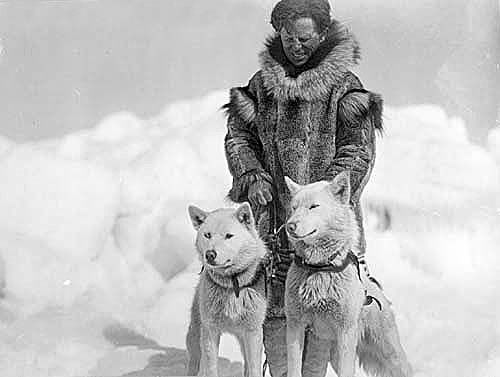 (Above: Seppala and two of his Siberians, in 1925 - the year of the Serum Run.)
 (Above: Seppala with his 1925 team. Togo is not pictured, but you can see that the "gang line" extends beyond the edge of the picture. Fritz, the second dog, and Togo, the lead dog, are probably out of the picture here. Seppala's special Serum Run team was said to be sixteen dogs.)
|
|
|
|
|
Posted: Wed Nov 22, 2006 11:00 pm |
|
|
|
| |
|
Posted: Thu Nov 23, 2006 8:51 am |
|
|
|
| |
|
Posted: Thu Nov 23, 2006 6:38 pm |
|
|
|
Highland Wolf wrote: Hmm, very good info! I have heard quite a lot about the All-Alaska Sweepstakes, you actually bet me to a topic about it!  heh heh...sorry Highland. I was in a historical mood the last couple of days! 
And more is coming!
|
|
|
|
|
Posted: Sat Nov 25, 2006 9:03 pm |
|
|
|
And so...to continue...
The 1925 Serum Run
By the time of the Serum Run (January 27th to February 2nd, 1925), Leonhard Seppala had become a legend all across Alaska, and into Siberia. And he became THE man to turn to with regard to Siberian huskies, and ONE of THE men with regard to dog sledding and mushing. He was a racing legend as well. So it should come as no surprise to the reader that, a quarter of a century after Seppala had first arrived in Nome (as a young man of 23, who was now almost 48 years old), it was HE whom the Governor of Alaska, Scott Bone (picture just below), and the local Nome government, turned to with regard to arranging the dog sled teams for at least the second half of the run (you can read a general, condensed history of the events leading up to the serum run, and the progress of the run itself, here, as I won't be retelling it in this topic in all but a few selected points): http://www.serumrun.org/History.htm.
 (Above: Scott C. Bone, governor of the U.S. territory of Alaska in 1925.)
By this time, Seppala had amassed quite the impressive collection of dog sledding equipment and expertise, and had an active and productive breeding program at work, with kennels in both his winter home of Nome, and his summer home up in Cape Horn (in the northeastern section of the Seward Peninsula, out on the tundra...a picture of that latter place is shown below).
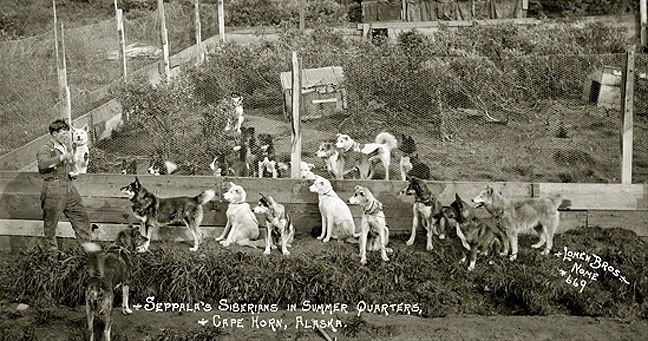 (Above: Seppala, or possibly his younger protege and fellow Norwegian, Gunnar Kaasen, at Sepp's summer kennels in Cape Horn, Alaska.)
After a lot of wrangling and failed plans were tossed around in the Alaskan government, and even on the floor of the U.S. Senate, it was decided that dog sled teams were the only way. Governor Bone asked for anyone who could coordinate the effort. The government of Nome had one man they'd be willing to to send: Seppala. He was contacted, and given the instructions to take a team out eastward, in the direction of Nenana (a small town near the city of Fairbanks). He was to meet with another musher ("Wild" Bill Shannon) at roughly the half-way point between Nome and Nenana (about 320 miles), who himself would be taking the diphtheria anti-toxin (serum) from the train station and out onto the trail towards Nome (there were no roads to Nome at that time from anywhere in the interior of Alaska, and no railways any further north or west, out of Anchorage, than Nenana itself). Shannon would end up relaying to other teams along his part of the route, because of trouble with inexperienced dogs.
Just before departing from Nome, Seppala left instructions with his young protege, Gunnar Kaasen, to keep a small team of 12 dogs on-hand to handle any local emergencies or work-related runs. In that team were the experienced leader, Fox, and a large black, and partially-white, husky, Balto (who had never led a team). Seppala instructed Kaasen to use FOX, the experienced dog, as his team leader. He then raced off towards Nenana. Once he was gone, the Governor of Alaska contacted the mayor of Nome, George Maynard, and arranged for a larger relay of teams. Kaasen, being Seppala's protege (and a local), was given a small section of the run near the very end. Seppala didn't find out about this until he met up with musher Henry Ivanoff's team almost in passing during a storm. He had already gone 170 miles over five days (January 27th to the 31st), in near gale-force winds (with a wind temperature of nearly -85°F) on the last day, and even crossed over the pack ice of Norton Sound to cut his travel distance, when Ivanoff spotted him and shouted "The serum! The serum! I have it here!"
With news of the diphtheria epidemic back in Nome worsening, Seppala decided to turn right around and head back across the pack ice of Norton Sound and into the darkness, with Togo (his experienced lead dog at an incredible 12 years of age) picking his way through the blinding gale and treacherous off-shore ice. On the 31st, they had traveled 84 miles, averaging 8 miles per hour, before stopping to rest. Setting out again at 2 A.M., they moved out onto the pack ice again (in an effort to save time), which was breaking up around them. The team became temporarily stranded when a floe broke loose from the ice, upon which the team became trapped. When the floe drifted back close to the pack ice, Seppala had Togo jump a five-foot gap in order to pull the floe closer to shore. But the lead snapped off his harness and fell into the frigid water. Togo, on his own, jumped into the water and retrieved the lead, and pulled (with encouragement from Seppala) until the floe drifted close enough for the rest of the team to cross (this event, according to Seppala, actually happened as described here). After traveling over a mountain range, they handed off the serum to musher Charles Olsen at Golovin (at 3 P.M.), who carried it onward. Seppala's team, with the heroic Togo in the lead, had traveled a grand total distance of 261 miles...more than five times as far as any other team in the run...including Balto's.
|
|
|
|
|
Who is online |
Users browsing this forum: No registered users and 0 guests |
|
You cannot post new topics in this forum
You cannot reply to topics in this forum
You cannot edit your posts in this forum
You cannot delete your posts in this forum
You cannot post attachments in this forum
|
|