Re: Snakes  Posted: Posted: Fri Mar 13, 2009 11:27 am |
|
|
|
| |
 |
Re: Snakes Posted: Fri Mar 13, 2009 5:16 pm |
|
Pirate480
Joined: Wed Sep 17, 2008 4:58 am
Posts: 674
Location: None of your business
Group / Pack: wind swift pack.nothing else
Gender: Male
|
|
 |
|
|
|
Aloha Aleu wrote: How about the Anaconda,and the Boa Constrictor? Andaconda's already there,but I'll add the Boa. Thanks for the suggestion.
_________________

sign by saske italian wolf
|
|
|
| |
|
Re: Snakes Posted: Fri Mar 13, 2009 10:43 pm |
|
Pirate480
Joined: Wed Sep 17, 2008 4:58 am
Posts: 674
Location: None of your business
Group / Pack: wind swift pack.nothing else
Gender: Male
|
|
|
|
|
|
Joker wrote: Aloha Aleu wrote: How about the Anaconda,and the Boa Constrictor? Andaconda's already there,but I'll add the Boa. Thanks for the suggestion. Here it is Boa Constrictor:( Boa Constrictor) is a well known species of Boa native to Central and South America including the carribean islands.The common name is the same as the scientific name, which is unusual as you people may have noticed.Adult sizes vary among the subspecies, although those found in northern South America reach the greatest lengths. The largest specimens on record are two from Suriname; one measuring 13.5 feet (4.1 m) and the other slightly over 14 feet (4.3 m). However, such sizes are very rare and on average 10 feet (3 m) is considered a large specimen.[3] There is also a report of an 18.5 foot (5.6 m) specimen from Trinidad, but this is now believed to have been a misidentified anaconda.The color pattern consists of a ruddy brown ground color, becoming a rich brick red on the tail. Dorsally, the ground color is overlaid with a series of large tan-colored saddles that become lighter towards the tail. Here, the saddles break up into half rings of a pale cream color in vivid contrast with the red. This animal usually flourishes in a varitey of enviroments from tropical rainforests to even an arid country. Small individuals may climb into trees and shrubs to forage, but they become mostly terrestrial as they become older and heavier.It is said that specimens from Central America are more irascible, hissing loudly and striking repeatedly when disturbed, while those from South America tame down more readily.It's diet includes are good variety of mammals,reptiles and birds.However they usually will prefer to concentrate mostly on rodents.This species does well in captivity, usually becoming quite tame. It is a common sight in zoos. Captive longevity is 20 to 30 years, with rare accounts of over 40 years, making them a long-term commitment as a pet. Proper animal husbandry is the most significant factor in captive lifespan. Though still exported from their native South America in significant numbers, it is widely bred in captivity. 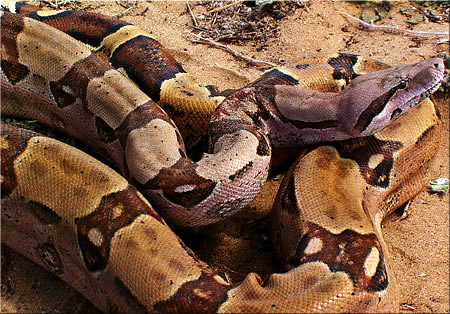
_________________
sign by saske italian wolf
|
|
|
| |
|
Re: Snakes Posted: Fri Mar 13, 2009 10:46 pm |
|
Celtic Toboe
 |
| Animation Source is my home! |
 |
 |
Joined: Tue Jul 12, 2005 1:40 am
Posts: 17716
Location: Raleigh,N.C.
Group / Pack: Computer programmer(novice)
Gender: Male
|
|
|
|
|
|
Joker wrote: Joker wrote: Aloha Aleu wrote: How about the Anaconda,and the Boa Constrictor? Andaconda's already there,but I'll add the Boa. Thanks for the suggestion. Here it is Boa Constrictor:( Boa Constrictor) is a well known species of Boa native to Central and South America including the carribean islands.The common name is the same as the scientific name, which is unusual as you people may have noticed.Adult sizes vary among the subspecies, although those found in northern South America reach the greatest lengths. The largest specimens on record are two from Suriname; one measuring 13.5 feet (4.1 m) and the other slightly over 14 feet (4.3 m). However, such sizes are very rare and on average 10 feet (3 m) is considered a large specimen.[3] There is also a report of an 18.5 foot (5.6 m) specimen from Trinidad, but this is now believed to have been a misidentified anaconda.The color pattern consists of a ruddy brown ground color, becoming a rich brick red on the tail. Dorsally, the ground color is overlaid with a series of large tan-colored saddles that become lighter towards the tail. Here, the saddles break up into half rings of a pale cream color in vivid contrast with the red. This animal usually flourishes in a varitey of enviroments from tropical rainforests to even an arid country. Small individuals may climb into trees and shrubs to forage, but they become mostly terrestrial as they become older and heavier.It is said that specimens from Central America are more irascible, hissing loudly and striking repeatedly when disturbed, while those from South America tame down more readily.It's diet includes are good variety of mammals,reptiles and birds.However they usually will prefer to concentrate mostly on rodents.This species does well in captivity, usually becoming quite tame. It is a common sight in zoos. Captive longevity is 20 to 30 years, with rare accounts of over 40 years, making them a long-term commitment as a pet. Proper animal husbandry is the most significant factor in captive lifespan. Though still exported from their native South America in significant numbers, it is widely bred in captivity. Nice job on the snake pic findings.
_________________
Avi and sig beautifully made by Hunter The Wolf 

|
|
|
| |
|
Re: Snakes Posted: Sat Mar 21, 2009 2:15 am |
|
|
|
| |
|
Re: Snakes Posted: Sun Apr 12, 2009 3:43 pm |
|
IloveCoryn
Joined: Fri Nov 21, 2008 8:30 pm
Posts: 189
Location: Eating Ice Cream Cake
Group / Pack: Got chased out
Gender: Female
|
|
|
|
|
|
|
Wow, you must like snakes a lot.
Maybe you could add my 2 favorite snakes- the Chicken Snake and Flying Snake.
_________________
If you like dogs and rp sites, help me defeat the awful cats in The Outlawed!
|
|
|
| |
|
Re: Snakes Posted: Tue Apr 14, 2009 1:35 am |
|
Pirate480
Joined: Wed Sep 17, 2008 4:58 am
Posts: 674
Location: None of your business
Group / Pack: wind swift pack.nothing else
Gender: Male
|
|
|
|
|
|
Graystripe wrote: Wow, you must like snakes a lot.
Maybe you could add my 2 favorite snakes- the Chicken Snake and Flying Snake. Of course,but those are the name of Genus,so I'll post a species from each. Corn Snake:( Elaphe guttata) also known as the Red Rat Sanke or the Chicken Snake is a small species of North american rat snake known for its useage of constriction to subdue it's prey.The purpose of the name is because of Maze-like patterns on the belly which are known to resemble a cornfield. The size is usually 1.2 to 1.8 meters in length.The coloring has apparently began to vary due to selective breeding in captivity with more than 20 different patterns! Wild Corn Snakes prefer habitats such as overgrown fields, forest openings, trees, and abandoned or seldom-used buildings and farms, from sea level to as high as 6,000 feet.They are found in the southeastern staes from New Jersey to Florida and as far west as texas.In colder regions, snakes hibernate during winter. However, in the more temperate climate along the coast they shelter in rock crevices and logs during cold weather, and come out on warm days to soak up the heat of the sun, a process known as brumation. Their diet is mostly based on rodents,but will also go for birds and bats.In their earlier years(Corn sanke live up to 20 years),they will often go for small lizardss such as Anoles.As stated earlier,Corn snakes use constriction to kill prey,which doesn't suffocation,but high blood pressure,the same technique is in boas,pythons and sometimes in king cobras. Due to their size,lack of venom,docile nature,reluctance to bite and life span,Corn Snakes are a firm favorite as pets with the coloring pattern being moore likely to vary. The corn snake in the picture is a wild born one.  Golden Tree Snake:( Chrysopelea ornata ornatissima) is handsome species of Colubrid.Despite the name, the attractive patterning is actually green or greenish-yellow on a black background with the belly being brightly colored.The body, though slender, is far less so than in other tree snakes. It has a flattened head with constricted neck, a blunt nose and large eyes with round pupils. The Geogarphic rasnge of this snake is southern based Asia the countries ofIndia, Sri Lanka, Myanmar, Thailand, western Malaysia, Laos, Cambodia, Vietnam, China (Hong Kong, Hainan, Yunnan), Indonesia (Sumatra, Java, Borneo, Sulawesi), and the Philippines. Chrysopelea ornata is diurnal and arboreal. The snake's gliding ability, while not as impressive as that of the Paradise Flying Snake (C. paradisi), still makes it capable of moving from tree to tree with relative ease. These snakes are excellent climbers, being able move across even the smallest of branches and even straight up trees with next to no branches by using the edges of rough bark. They are frequently seen moving up a Coconut palm, or up vertical rock-faces in graceful curves gripping the somewhat uneven surface with their scales. They tend to be nervous, fast moving snakes, and will attempt to flee if disturbed, but will not generally hesitate to bite if handled.This species' venom is quite mild and shouldn't cause any signifant effects. Chrysopelea ornata, like others of its genus, glides or parachutes. This is presumably done to cover distances faster, to escape predators, to catch prey, or to move around in forests. Flying snakes usually parachute from tree to tree, but sometimes launch themselves from trees onto the ground. They have been known to cross as much as 100m. It does this by climbing up to a height, which it does easily by virtue of its keeled belly scales, and then launching itself into mid-air. The snake contracts its ventral surface inwards to form a U-shaped concave depression along the entire length of their bodies, holding the outer edges of the ventral scales rigid. This concave surface acts like a parachute, and increases air resistance allowing the snake to glide forward with the thrust of its launch. The snake undulates through the air, in a swimming-like motion. It holds the tail rigidly upwards and by twisting the tail from side to side, it attains balance. This motion allows it to propel forward, landing clumsily at the end of its flight. In recent years, ornate flying snakes have become increasingly available in the exotic pet trade, many exported from Vietnam and neighboring countries. Instances of captive breeding are virtually unknown. Due to the species' nervous temperament and difficulty to adjusting to captivity, they tend to make poor captives for all but the most experienced reptile keepers.It isn't a species I would recommend. 
_________________
sign by saske italian wolf
|
|
|
| |
|
Re: Snakes Posted: Tue Apr 21, 2009 9:22 pm |
|
IloveCoryn
Joined: Fri Nov 21, 2008 8:30 pm
Posts: 189
Location: Eating Ice Cream Cake
Group / Pack: Got chased out
Gender: Female
|
|
|
|
|
|
Joker wrote: Graystripe wrote: Wow, you must like snakes a lot.
Maybe you could add my 2 favorite snakes- the Chicken Snake and Flying Snake. Of course,but those are the name of Genus,so I'll post a species from each. Corn Snake:( Elaphe guttata) also known as the Red Rat Sanke or the Chicken Snake is a small species of North american rat snake known for its useage of constriction to subdue it's prey.The purpose of the name is because of Maze-like patterns on the belly which are known to resemble a cornfield. The size is usually 1.2 to 1.8 meters in length.The coloring has apparently began to vary due to selective breeding in captivity with more than 20 different patterns! Wild Corn Snakes prefer habitats such as overgrown fields, forest openings, trees, and abandoned or seldom-used buildings and farms, from sea level to as high as 6,000 feet.They are found in the southeastern staes from New Jersey to Florida and as far west as texas.In colder regions, snakes hibernate during winter. However, in the more temperate climate along the coast they shelter in rock crevices and logs during cold weather, and come out on warm days to soak up the heat of the sun, a process known as brumation. Their diet is mostly based on rodents,but will also go for birds and bats.In their earlier years(Corn sanke live up to 20 years),they will often go for small lizardss such as Anoles.As stated earlier,Corn snakes use constriction to kill prey,which doesn't suffocation,but high blood pressure,the same technique is in boas,pythons and sometimes in king cobras. Due to their size,lack of venom,docile nature,reluctance to bite and life span,Corn Snakes are a firm favorite as pets with the coloring pattern being moore likely to vary. The corn snake in the picture is a wild born one. Golden Tree Snake:( Chrysopelea ornata ornatissima) is handsome species of Colubrid.Despite the name, the attractive patterning is actually green or greenish-yellow on a black background with the belly being brightly colored.The body, though slender, is far less so than in other tree snakes. It has a flattened head with constricted neck, a blunt nose and large eyes with round pupils. The Geogarphic rasnge of this snake is southern based Asia the countries ofIndia, Sri Lanka, Myanmar, Thailand, western Malaysia, Laos, Cambodia, Vietnam, China (Hong Kong, Hainan, Yunnan), Indonesia (Sumatra, Java, Borneo, Sulawesi), and the Philippines. Chrysopelea ornata is diurnal and arboreal. The snake's gliding ability, while not as impressive as that of the Paradise Flying Snake (C. paradisi), still makes it capable of moving from tree to tree with relative ease. These snakes are excellent climbers, being able move across even the smallest of branches and even straight up trees with next to no branches by using the edges of rough bark. They are frequently seen moving up a Coconut palm, or up vertical rock-faces in graceful curves gripping the somewhat uneven surface with their scales. They tend to be nervous, fast moving snakes, and will attempt to flee if disturbed, but will not generally hesitate to bite if handled.This species' venom is quite mild and shouldn't cause any signifant effects. Chrysopelea ornata, like others of its genus, glides or parachutes. This is presumably done to cover distances faster, to escape predators, to catch prey, or to move around in forests. Flying snakes usually parachute from tree to tree, but sometimes launch themselves from trees onto the ground. They have been known to cross as much as 100m. It does this by climbing up to a height, which it does easily by virtue of its keeled belly scales, and then launching itself into mid-air. The snake contracts its ventral surface inwards to form a U-shaped concave depression along the entire length of their bodies, holding the outer edges of the ventral scales rigid. This concave surface acts like a parachute, and increases air resistance allowing the snake to glide forward with the thrust of its launch. The snake undulates through the air, in a swimming-like motion. It holds the tail rigidly upwards and by twisting the tail from side to side, it attains balance. This motion allows it to propel forward, landing clumsily at the end of its flight. In recent years, ornate flying snakes have become increasingly available in the exotic pet trade, many exported from Vietnam and neighboring countries. Instances of captive breeding are virtually unknown. Due to the species' nervous temperament and difficulty to adjusting to captivity, they tend to make poor captives for all but the most experienced reptile keepers.It isn't a species I would recommend. Nice! I used to live in a house with well that had two corn snakes in it. We got them out but the were dead (they stunk too). Also my dad once run over a gradener snake with a lawn mower! Luckly, it survive. I used to live in a place swaming with gradener snakes. They were even in my basment.
_________________
If you like dogs and rp sites, help me defeat the awful cats in The Outlawed!
Last edited by IloveCoryn on Sat Apr 25, 2009 11:12 am, edited 1 time in total.
|
|
|
| |
|
Re: Snakes Posted: Wed Apr 22, 2009 10:28 pm |
|
Pirate480
Joined: Wed Sep 17, 2008 4:58 am
Posts: 674
Location: None of your business
Group / Pack: wind swift pack.nothing else
Gender: Male
|
|
|
|
|
|
Graystripe wrote: Joker wrote: Graystripe wrote: Wow, you must like snakes a lot.
Maybe you could add my 2 favorite snakes- the Chicken Snake and Flying Snake. Of course,but those are the name of Genus,so I'll post a species from each. Corn Snake:( Elaphe guttata) also known as the Red Rat Sanke or the Chicken Snake is a small species of North american rat snake known for its useage of constriction to subdue it's prey.The purpose of the name is because of Maze-like patterns on the belly which are known to resemble a cornfield. The size is usually 1.2 to 1.8 meters in length.The coloring has apparently began to vary due to selective breeding in captivity with more than 20 different patterns! Wild Corn Snakes prefer habitats such as overgrown fields, forest openings, trees, and abandoned or seldom-used buildings and farms, from sea level to as high as 6,000 feet.They are found in the southeastern staes from New Jersey to Florida and as far west as texas.In colder regions, snakes hibernate during winter. However, in the more temperate climate along the coast they shelter in rock crevices and logs during cold weather, and come out on warm days to soak up the heat of the sun, a process known as brumation. Their diet is mostly based on rodents,but will also go for birds and bats.In their earlier years(Corn sanke live up to 20 years),they will often go for small lizardss such as Anoles.As stated earlier,Corn snakes use constriction to kill prey,which doesn't suffocation,but high blood pressure,the same technique is in boas,pythons and sometimes in king cobras. Due to their size,lack of venom,docile nature,reluctance to bite and life span,Corn Snakes are a firm favorite as pets with the coloring pattern being moore likely to vary. The corn snake in the picture is a wild born one. Golden Tree Snake:( Chrysopelea ornata ornatissima) is handsome species of Colubrid.Despite the name, the attractive patterning is actually green or greenish-yellow on a black background with the belly being brightly colored.The body, though slender, is far less so than in other tree snakes. It has a flattened head with constricted neck, a blunt nose and large eyes with round pupils. The Geogarphic rasnge of this snake is southern based Asia the countries ofIndia, Sri Lanka, Myanmar, Thailand, western Malaysia, Laos, Cambodia, Vietnam, China (Hong Kong, Hainan, Yunnan), Indonesia (Sumatra, Java, Borneo, Sulawesi), and the Philippines. Chrysopelea ornata is diurnal and arboreal. The snake's gliding ability, while not as impressive as that of the Paradise Flying Snake (C. paradisi), still makes it capable of moving from tree to tree with relative ease. These snakes are excellent climbers, being able move across even the smallest of branches and even straight up trees with next to no branches by using the edges of rough bark. They are frequently seen moving up a Coconut palm, or up vertical rock-faces in graceful curves gripping the somewhat uneven surface with their scales. They tend to be nervous, fast moving snakes, and will attempt to flee if disturbed, but will not generally hesitate to bite if handled.This species' venom is quite mild and shouldn't cause any signifant effects. Chrysopelea ornata, like others of its genus, glides or parachutes. This is presumably done to cover distances faster, to escape predators, to catch prey, or to move around in forests. Flying snakes usually parachute from tree to tree, but sometimes launch themselves from trees onto the ground. They have been known to cross as much as 100m. It does this by climbing up to a height, which it does easily by virtue of its keeled belly scales, and then launching itself into mid-air. The snake contracts its ventral surface inwards to form a U-shaped concave depression along the entire length of their bodies, holding the outer edges of the ventral scales rigid. This concave surface acts like a parachute, and increases air resistance allowing the snake to glide forward with the thrust of its launch. The snake undulates through the air, in a swimming-like motion. It holds the tail rigidly upwards and by twisting the tail from side to side, it attains balance. This motion allows it to propel forward, landing clumsily at the end of its flight. In recent years, ornate flying snakes have become increasingly available in the exotic pet trade, many exported from Vietnam and neighboring countries. Instances of captive breeding are virtually unknown. Due to the species' nervous temperament and difficulty to adjusting to captivity, they tend to make poor captives for all but the most experienced reptile keepers.It isn't a species I would recommend. Nice! I used to live in a house with well that had two corn snakes in it. We got them out but the were dead (they stunk too). Also my dad once run over a gradener snake with a lawn mower! Luckly, it survive. I used to live it a place swaming with gradener snakes. They were even in my basment. Yeah,where I live there are countless numbers of garden snakes
_________________
sign by saske italian wolf
|
|
|
| |
|
Re: Snakes Posted: Sat Apr 25, 2009 11:14 am |
|
IloveCoryn
Joined: Fri Nov 21, 2008 8:30 pm
Posts: 189
Location: Eating Ice Cream Cake
Group / Pack: Got chased out
Gender: Female
|
|
|
|
|
|
|
Is it true that graden snakes give off a stink when frighten?
_________________
If you like dogs and rp sites, help me defeat the awful cats in The Outlawed!
|
|
|
| |
|
Re: Snakes Posted: Sun Apr 26, 2009 2:54 am |
|
|
|
| |
|
Re: Snakes Posted: Mon May 04, 2009 8:58 pm |
|
Pirate480
Joined: Wed Sep 17, 2008 4:58 am
Posts: 674
Location: None of your business
Group / Pack: wind swift pack.nothing else
Gender: Male
|
|
|
|
|
|
Graystripe wrote: Is it true that graden snakes give off a stink when frighten? Not that I know of.was it a rumor or something that you heard? whitewolf17 wrote: Could ya add the Orochi? (jk)
In all serious-ness could ya add the garden snake if it's not there already? sure i could add a garter snake,but toget it clear on Orochi,you want me to add the legendary 8 headed dragon of japan?
_________________
sign by saske italian wolf
|
|
|
| |
|
Re: Snakes Posted: Wed Jun 17, 2009 4:00 pm |
|
ResidentEvilfan
|
| Newcomer |
 |
Joined: Sat Oct 25, 2008 1:07 pm
Posts: 29
Gender: Female
|
|
|
|
|
|
|
|
| |
|
Who is online |
Users browsing this forum: No registered users and 0 guests |
|
You cannot post new topics in this forum
You cannot reply to topics in this forum
You cannot edit your posts in this forum
You cannot delete your posts in this forum
You cannot post attachments in this forum
|
|