

A guide on horse behaviour in wild/feral herds and a reflection on the Cimarron herd
.png)
PHOTO © AMERICAN WILD HORSE CAMPAIGN
BEHAVIOUR: WILD HORSES
COMPILED BY TARUNYADA
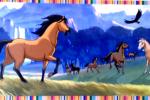
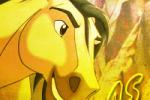
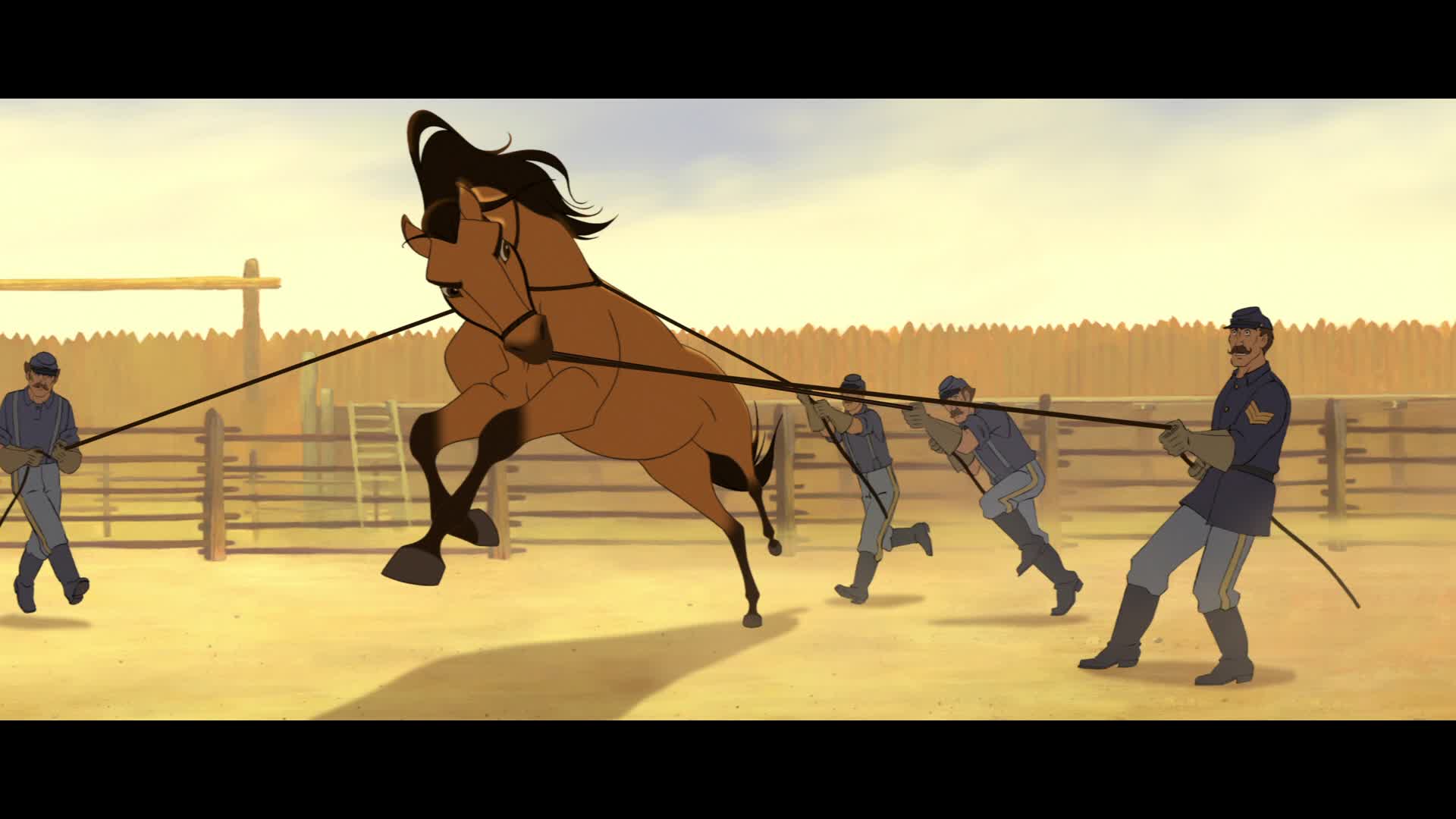
In SPIRIT: STALLION OF THE CIMARRON, Spirit is the lead stallion of the Cimarron herd. During the movie's introduction, we even hear him say: "Like my father before me, I became leader of the Cimarron herd (..)". But what about natural horse behaviour? How do herds of wild horses work?
---
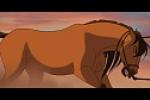
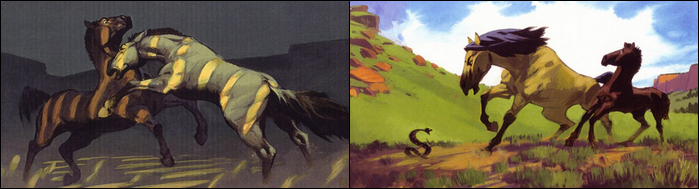
Contrary to the movie, in natural horse behaviour the herd stallion is not the leader ("ruler") of a herd of mares. Stallions usually engage in herding and protective behaviour. They tend to stay on the periphery of the herd where they fight off both predators and other males. When the herd travels, the stallion can usually be found at the rear of the group. Apparently he drives straggling herd members forward, keeping the herd together. Mares and lower-ranked males do not usually engage in this herding behaviour. Stallions tend to act more aggressively to keep the mares within the herd during the mating season (in spring). However, most of the time, the stallion is relaxed and spends much of his time "guarding" the herd. By scent-marking manure piles and urination spots, he communicates his dominance as herd stallion.
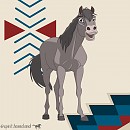
 CONCEPT ART © DREAMWORKS
Rather, the horse that tends to lead a wild or feral herd is most commonly a dominant mare. The mare guides the herd to food and water, controls the daily routine and movement of the herd, and ensures the general wellbeing of the herd.
A recent supplement theory states that there is "distributed leadership": no single individual is an universal herd leader. A 2014 study of feral horses in Italy observes that some herd movements may be initiated by any individual, although higher-ranked members are followed more often by the other herd members.
Most young horses in the wild are allowed to stay within the herd until they reach sexual maturity (usually in their first of second year). Studies of wild herds have shown that the herd stallion will usually drive out both colts and fillies, which may be an instinct to prevent inbreeding. The fillies usually join another band soon afterwards, and colts from several herds usually join together in small "bachelor" groups until those who are able to establish dominance over an older stallion in another herd.
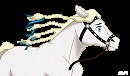
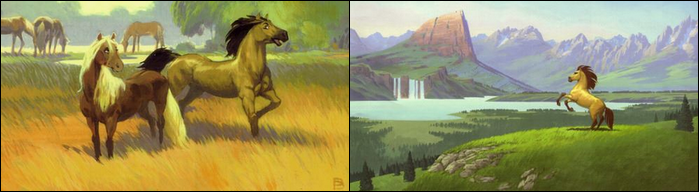 CONCEPT ART © DREAMWORKS
Herds are usually made up of several seperate, small "bands" which share a territory. Size may range from two to 25 individuals, consisting of mostly mares and their offspring, with one to five stallions. Each band is led by a dominant mare ("lead mare"). The composition of bands changes as young animals are driven out of their natural band and join other bands, or as stallions challenge each other for dominance.
In bands, there is usually a single "herd" stallion, though occassionally a few less-dominant males may remain on the outskirts of the group. The reproductive success of the herd stallion is determined in part by his ability to prevent other males from mating with the mares of his harem. The stallion also exercises protective behaviour, patrolling around the band, and taking initiative when the band encounters a potentional threat. The stability of the band is not affected by size, but tends to be more stable when there are subordinate stallions attached to the harem.
---
Projecting this knowledge back on the movie means this:
It is most likely that Esperanza is the lead mare of the Cimarron herd. That makes Spirit the herd stallion. He either fought off his father, Strider, when he was old and strong enough (after being driven out), or Strider died and Spirit took his place. The foals in the movie are most likely Spirit's offspring. Well, and Rain.. has to get used on sharing Spirit with the other mares!
---
GLOSSARY (in terms of horse behaviour)
- HAREM. A group of horses lead by a dominant "lead mare", consisting of several mares and their offspring, and usually not more than one stallion.
- PERIPHERY The outer limits of the range of a herd/harem, where the herd stallion fights off predators and other stallions.
- HERD STALLION. A lone stallion that guards and protects the mares in a harem/herd. This stallion is also the one that reproduces with the mares in the harem/herd.
- LEAD MARE. A dominant mare that leads the harem/herd.
- BACHELOR GROUPS. Small groups of young stallions, driven out by their herd stallion. They join together until they are able to form their own harems/herds, or take over dominance from a herd stallion.
- BANDS. Small groups of mares. Several bands make up a herd, which shares a territory.
---
SOURCES (through Wikipedia)
- Author unknown, s.a.: ADVS 3910 Wild Horses Behavior, PDF.
- Hallberg, L., 2008: Walking the Way of the Horse: Exploring the Power of the Horse-Human Relationship, iUniverse (page 144).
- Kincaid, A.T., 2008: Wild or Feral? Historical and Biological Consideration of Free Roaming Horses (FRH) in Alberta, PDF.
- Krueger, K./B. Flauger/K. Farmer/C. Hemelrijk, 2014: Movement Initiation in Groups of Feral Horses, Behavioural Process (103, pages 91-101).
- McGreevy, P., 2004: Equine Behavior, Saunders Company.
- Mistral, K., 2006: The Secret Life of Stallions, Horse Connection.
- Pacheco, M.A./E.A. Herrera, 1997: Social Structure of Feral Horses in the Llanos of Venezuela, Journal of Mammalogy (Volume 78, Issue 1, pages 15-22).
- Stevens, E.F., 1990: Instability of Harems of Feral Horses in Relation to Season and Presence of Subordinate Stallions, Behaviour (112, 3/4, pages 149-161).







 25598 visits
 Report this article