Facts About The Real Balto
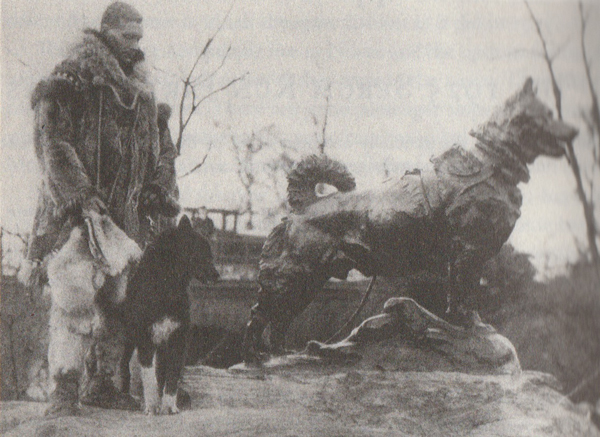
Gunnar Kaasen and Balto at the unveiling ceremony of Balto's statue in Central Park, NY, on December 16th, 1925.
Name: Balto was named after Samuel Balto, a Norwegian Sami explore and adventurer. In 1888, Fridtjof Nansen recruited Samuel for his Greenland Expidition, which ended up being a record crossing. Samuel moved to Alaska the following year and worked as a reindeer hearder. In 1921, Saumuel passed away in Karasjok, AK.
Breed: Unlike the animated film produced by Universal Studios in 1995, Balto was not a stray wolf hybrid, but a Siberian Husky. He was owned by Leonhard Seppala, and was used for hauling freight and supplies for the Hammon mining company.
Birth: There is no known documentation of Balto's date of birth, or even who his parents were. However, in the book The Cruelest Miles, Leonhard Seppala once claimed that Balto was only six years old during the time of the run, which suggests he may have been born sometime in 1919. That being said, a quote from a book can't be deemed as a fact if it can't be verified, so no one can say for certian when Balto was born.
Appearance: Balto was a large, black and white husky with brown eyes.
Offspring: Due to Balto's boxy anatomy, Leonhard had Balto neutured when he was six months of age.
Death: In March of 1933, the zoo keeper, Captain Curly Wilson, announced that Balto's health was rapidly deteriorating (he was partially deaf and blind) and had little time left. Dr. R.R. Powell, a veterinarian and trustee of the Balto committee, offered to care for Balto in his remaining days. On March 14th, Balto passed away.
"Balto Dies-as he raced to Nome-Without Audience"
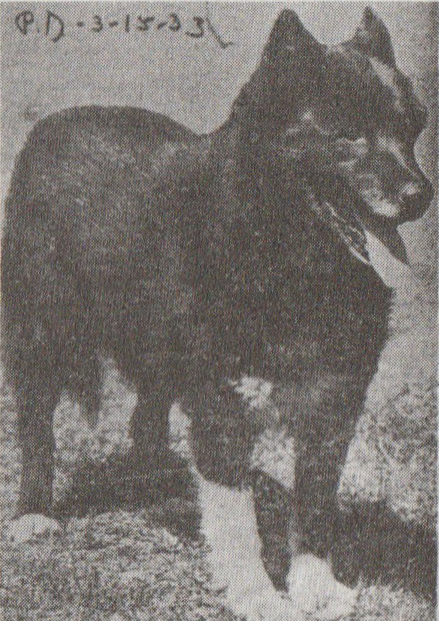
The above photo ran in Balto's obituary.
Balto's obituary ran in the Cleveland Plain dealer and the Cleveland Press on March 15th, 1933. Balto's pelt was then preserved and put up for display at the Cleveland museum of Natural History.
Leonhard Seppala and Gunnar Kaasen's realtion with Balto
Leonhard Seppla didn't dislike Balto (although he wasn't happy with all of the attention that Balto was receving, and resetnted his statue), but simply saw him as a dog that was only suitable for hauling supplies. As quoted in The Cruelest Miles, Seppala says that he never hoped to be the man to take away the credit from any dog or man that participated in the run. For if any dog deserved a special mention, it was Togo.
Gunnar Kaasen, a friend who worked along side Seppala at the Hammon mining company, saw more in Balto, and worked with him often. During the serum run, Leonhard Seppala stated that if Hammon needed a team for company business, to put Fox, a black and brown Husky who worked closely with Seppala, as lead dog. However, Gunnar ignored Seppala's advice and put Balto in the lead position.
On Tour
Within hours of Kaasen's arrival to Nome with the serum, several news organizations sent out dispatches over the radio and telegraph to announce the success of Gunnar Kaasen and his team. Within days, dozens of letters and poems that were addressed to Balto was pouring into Nome's small post office. The local school children did their best to respond to the letters and poems.
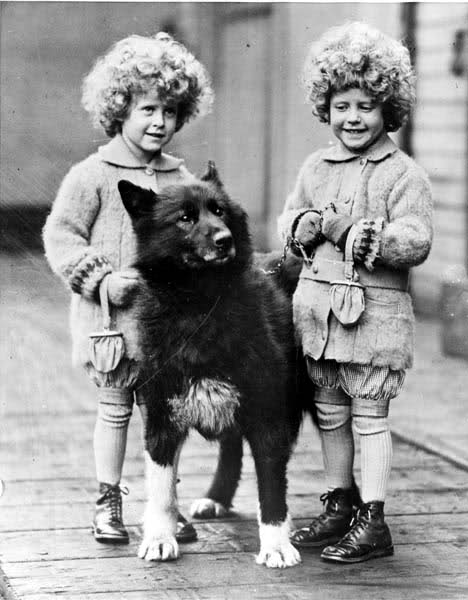 By late February of 1925, Kaasen had a movie deal and tour lined up in the United States. Upon their arrival to Seattle, Kaasen, his wife, and his dogs were greeted by the welcoming committee, and were presented the key to the city. The youngest members of the committee were the Quakenbush twins. They can be seen standing next to Balto to your left.
Weeks after arriving in Los Angeleas, Kaasen and the dogs took part in their brief movie career with Sol Lesser, a Hollywood film producer. They took part in a thirty minute film called Balto's Race to Nome, which they also promoted. While touring the West Coast, the parks commissioner of New York City announced that a statue of Balto was going to be constructed in Central Park.
Nine months later on December 16th, 1925, Kaasen and Balto appeared for the unveiling of the statue. Balto took no interest in the event and stood quietly next to Kaasen. After the unveiling, Kaasen recived a notice that Seppala wanted him toreturn to Nome, so Gunnar left the dogs behind with the promoter who purchased the team.
After returning to LA, Balto and his remaining team mates were struggling to survive. They had become apart of a sideshow attraction where men would pay a dime to walk into a room to see them. Balto and his team mates sat in that room for months until a gentleman named George Kimble, a business man from Cleveland, recognized them. The owner said he would let the dogs go if he could come up with two grand in one week. It was decided that the school kids of Cleveland would help raise the money. After ten days, the school children had raised enough money to purchase the dogs.
On March 19th, 1927, Balto and his six remaining team mates made it to Cleveland to live out the rest of their lives in peace, and were given a hero's welcome as they paraded through the town. The first to die was Fox, Moctoc, Tillie, Alaska Slim and billy. The last dog to die was Sye. Sye missed his companions dearly, and reports claim that he howled out of loneliness. On March 25th, 1934, Sye passed away at the age of seventeen.
The Cleveland Museum
After Balto's passing, he was preserved and put on display at the Cleveland Museum Of Natural History. However, Balto's mount was exposed to artifical and natural lighting for quite some time, so this caused his pelt faded from its original jet black to the mahogany brown it's today. Balto is now displayed under low-light conditions.

As you can see, the photo to the left is far more dark than the one to the right. If Balto were to be brown he would look like that in all of his photos. There is also this photo which was taken shortly after Balto was put up for display in the museum. You can clearly see Balto's pelt was the same tone as it was when he was alive.
Siberian Husky color links:
http://www.kianasiberians.com/colors.htm
http://cowgirl0216.hubpages.com/hub/Colors-of-Siberian-Huskies
http://www.huskycolors.com/mblack.html
www.huskycolors.com/mblack.html
BALTO RETURNS TO ALASKA FOR A BREIF TIME
For the second time in ninteen years, Balto returned to Alaska for four months. He, along side Togo (who's on display until September 17th, 2017), was apart of an exhibit called the "Polar Bear Garden" in Anchorage. Not only does the exhibit celebrate the 150 year purchase of Alaska from Russia, but they're also celebrating connections from both sides.
Just as a note, Balto and Togo's mounts aren't a true representation of their "builds". When a pelt is preserved, it's streched over a mount that's appropiet for the species in question. While it may come very close to what it once was when it was alive, it will never have the same characrtistics from when the animal was alive. In Balto and Togo's case, their pelts were likely streched over a wire and cotton mount.
Videos of Balto
Balto and Gunnar Kaasen at the unveiling ceremony of Balto's statue on December 16th, 1925.
This was an reenactment of the team bringing in the serum for the news media.
Links:
http://www.baltostruestory.net
http://www.amazon.com/The-Cruelest-Miles-Against-Epidemic/dp/0393325709

 43886 visits


 The true Balto